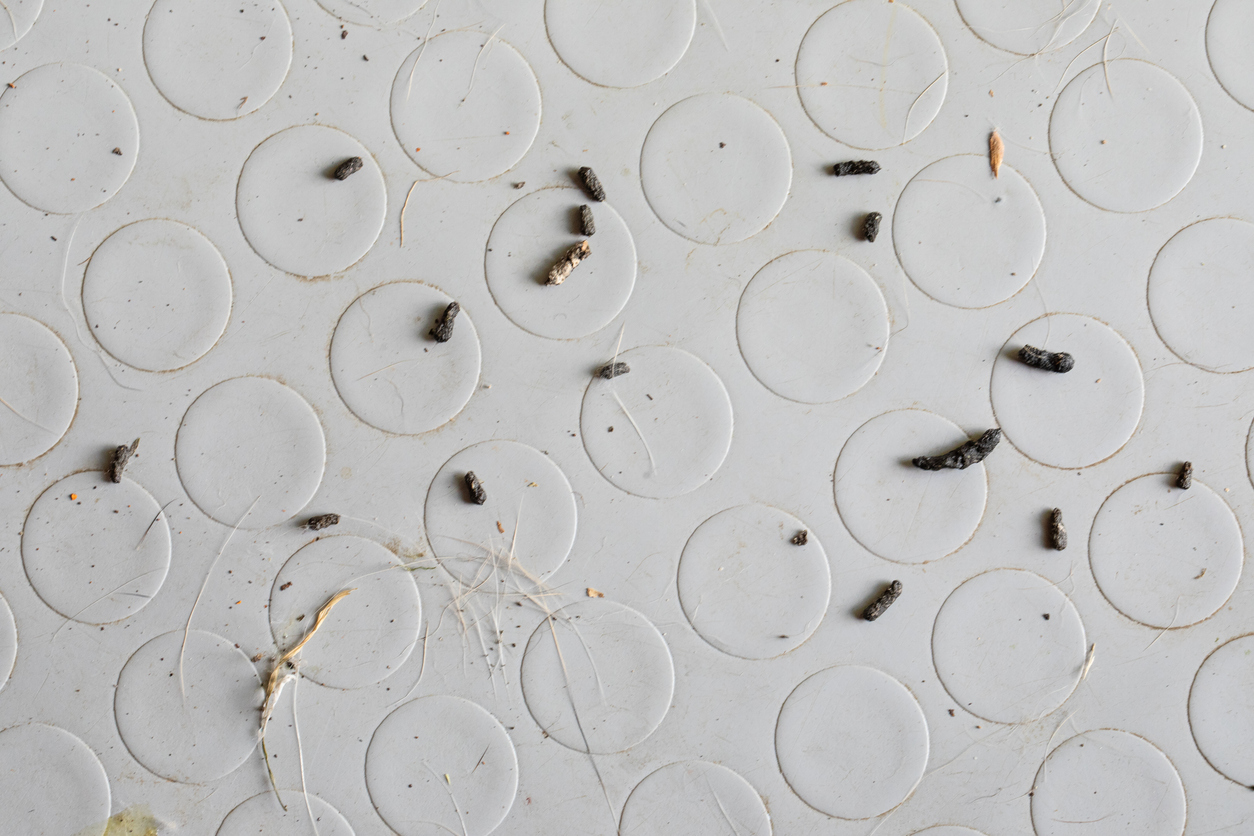
Finding a few small, dark pellets in a kitchen cabinet, basement, or garage can quickly raise an uncomfortable question.
Is this mouse poop?
Mouse droppings are one of the most common signs that mice have been active inside a home. They are usually small, dark and narrow, but size and appearance can vary depending on how fresh they are. Knowing what to look for can help you tell mouse droppings apart from rat droppings and other household debris, and it can also give you a better idea of whether rodent activity is still ongoing.
If you think you have found mouse poop, avoid sweeping or vacuuming it up dry. Clean rodent waste carefully because disturbing contaminated material can send particles into the air. The CDC recommends wetting droppings thoroughly with disinfectant before removing them.
What Does Mouse Poop Look Like?
Mouse droppings are small, dark, narrow pellets that resemble a grain of rice (typically about 1/4 inch long). Fresh droppings are usually dark brown or nearly black and may look slightly shiny, but they become drier, duller, and lighter over time. They are usually tapered or pointed at one or both ends and are found scattered along travel routes rather than grouped in a single pile. As a snapshot, mouse droppings generally look like this:
- Size: Around 1/4 inch long, making them significantly smaller than rat droppings.
- Color: Dark brown to black when fresh, fading and dulling as they age.
- Shape: Rice-like and narrow, often pointed at the ends.
- Distribution: Scattered along walls, cabinets, and travel routes.
Additionally, seeing a mix of fresh, shiny pellets alongside duller, older ones strongly suggests ongoing rodent activity over time.
For some homeowners, mouse and rat droppings may look similar. However, telling them apart matters and starts with size. Mouse poop typically measures about 1/4 inch long and has pointed ends. In comparison, rat droppings are significantly larger and thicker (usually measuring roughly 1/2 inch (for roof rats) to 3/4 inch long (for Norway rats) with capsule- or spindle-shaped ends. Both species leave dark brown to black droppings when fresh, but if the pellets you find are noticeably larger and chunkier, rats are a much more likely source.
Where Do You Usually Find Mouse Droppings?
Mice tend to leave droppings where they travel, eat, and nest. In fact, the CDC notes that rodent droppings are often found in cabinets, drawers and other areas that are out of plain sight, such as:
- Pantries
- Under sinks
- Behind refrigerators and stoves
- Along baseboards
- Basements
- Attics
- Garages
- Closets and storage rooms
- Near pet food
- Around stored boxes
- Near holes or gaps in walls
Does Mouse Poop Smell?
A few individual mouse droppings may not produce an obvious odor on their own. However, more mouse waste can create a strong musky smell, especially when droppings mix with urine in enclosed spaces. Cabinets, wall voids, attics and storage areas can hold odors more readily than open areas.
In many cases, the smell homeowners associate with a mouse infestation comes more from urine than from the droppings themselves. If you notice a strong ammonia-like or musky odor, it’s time to look more closely for mouse urine and where odors tend to build up.
Does Fresh Mouse Poop Mean Mice Are Still Active?
Possibly, but appearance alone isn’t a reliable way to tell whether mice are still present. Fresh droppings generally look darker, softer, and shinier, while older droppings become harder and duller. A more reliable approach is to clean the area and monitor it safely. For instance, if new droppings appear after cleanup, that indicates active rodent presence.
If you repeatedly find new droppings in the same cabinets, drawers, or along the same travel routes, that is a stronger sign that mice are still using the area.
How Much Mouse Poop Signals an Infestation
No exact number of droppings proves how many mice are present. One mouse can leave multiple droppings as it moves, and hidden areas may contain waste that has accumulated over time. What matters more is the pattern and the following should cause some concern if:
- New droppings appear after cleanup
- Droppings are present in multiple rooms
- You find both fresh- and old-looking pellets
- Droppings appear near food
- You hear scratching or scurrying
- You notice gnaw marks
- You see a mouse during the day
That last sign can be a particularly important signal of a mouse infestation. For example, regular daytime sightings can sometimes indicate greater competition or a larger mouse population.
Is Mouse Poop Dangerous?
Handle rodent droppings carefully because mice and other rodents can carry diseases, and some infections can spread when contaminated urine, droppings, or nesting material is disturbed. However, the CDC specifically warns against sweeping or vacuuming dry rodent droppings because this can put contaminated particles into the air. For standard home cleanup, follow a straightforward process aligned with CDC guidelines:
- thoroughly soak the pellets with disinfectant.
- wipe them away with paper towels.
- sanitize the surrounding surface.
That does not mean every mouse dropping contains a disease-causing organism. It does mean you should use appropriate precautions rather than handling or cleaning rodent waste like ordinary household dirt. However, if you have extensive waste buildup, a heavy infestation, or contamination in hard-to-reach spaces like ductwork, hiring a professional service is often the best and safest option.
Why Do Mouse Droppings Keep Appearing After I Clean Them?
If new droppings appear after you have safely cleaned an area, mice are still getting into or traveling through that space. That may mean they are:
- Nesting nearby
- Using the area as a travel route
- Reaching a food or water source
- Entering through a nearby gap
- Moving between wall voids and living spaces
At that point, cleanup alone will not solve the underlying problem. You need to identify where the mice are entering, where they may be nesting and what is attracting them.
What Should You Do If You Find Mouse Droppings in Your Home?
Safely clean up the droppings first, but the bigger question is why they are there. If new mouse poop continues appearing, especially in multiple locations, the infestation may be larger than what you can see. Look for other evidence such as:
- Gnaw marks
- Damaged food packages
- Scratching inside walls
- Nesting material
- Mouse urine odors
- Daytime mouse sightings
If the activity continues, it may be time to bring in a professional. Cleaning up the droppings removes the evidence. Finding and addressing the source is what helps keep them from coming back.
Eliminate ’Em provides professional mice exterminator services throughout Connecticut and Rhode Island, as well as across neighborhoods in Western Massachusetts and Southern New York. A professional inspection can help identify where mice are nesting, how they are getting inside, and what you need to do to remove them and reduce the chances of another infestation.
Proactive preventative measures are the best way to address the underlying factors that draw mice and other rodents to your home. If you are dealing with an active rodent issue, turn to the experts at Eliminate ‘Em. Our experienced pest control specialists will eliminate your current infestation and implement targeted solutions to safeguard your property moving forward. To arrange fast mouse removal or learn more about our comprehensive pest control services, contact us today.